Thursday, April 23, 2015

New Foundations


In Monday’s post I discussed the importance of faith impacting every aspect of one’s life. Many people agree with that sentiment, but it can be challenging to actually implement it, beyond the basics of living rightly. How to we build our entire life on our faith?

In other words, faith-impacting-life is about more than morality… it goes deeper than that. But how? How am I to bring my faith to bear on my life in a deep and substantial way? How am I accomplish living in a way that is thoroughly structured by my faith instead of by the world?

One important answer is this: by saturating myself in the liturgical life of the Church, by allowing the rhythm of the liturgical day, week and year to form and shape my life.

To that end and to get some specific proposals, I’d recommend this post on “Living Liturgically”. The author, Michael Bradley, gives some examples on how he strives to “live liturgically”:
I try, now, though so far with little success, to orient my instinctive reactions to days of the week or weeks of the month or seasons of the year more toward the liturgical calendar and away from secular calibration. I try to reflect on the sorrowful mysteries even amid the excitement of an impending Friday night. I try to work more on Saturdays so that I can stay away from the computer on Sundays, or maybe plan to socialize on Saturday evening so that I can dedicate my Friday night to something other than a major social event. I try to greet solemnities with the same general excitement that the Fourth of July elicits in me.

A personal example: for a number of years now I’ve tried to take seriously the Church’s expectation that we perform some penance on each Friday of the year. I do this in part out of a desire to shape my life by my faith: because Jesus died on the Cross for me and for all on a Friday, I try to offer some act of penance, in union with His ultimate self-sacrifice.

Another (one-time) example: a couple years ago my family organized a Pentecost Party to observe this great solemnity that has essentially no significance in our culture.

In this and other examples, my desire is that observing and celebrating the liturgical calendar will -- over time --shape my life "Christianly," to make it... cruciform.

Again, this is a theme to which I will return repeatedly, but for now, this will suffice as a short introduction, to hopefully whet your appetite.

What about you? How have you used the liturgical calendar to bring your faith into your life?

Tuesday, April 21, 2015

Good News, Not Good Advice

Christians in the First World today have a serious image problem, one which cripples our attempts to share our faith with others, and -- sadly -- one which is in many ways our own doing. As the Anglican scholar N.T. Wright has noted, the unfortunate reality is that many people -- including many Christians! -- have fundamentally misunderstood the Gospel of Jesus Christ as Good (or Not So Good) Advice.

To put it another way, many people -- again, including many Christians -- see the essence of Christianity as a moral code, as a set of rules and regulations which require certain behaviors and forbid others, as a bunch of "Thou Shalt Not's".


We’ll dive deeper into this topic in other posts, but for now I simply want to note that while Christianity certainly entails a morality, it is not, at its heart, defined as a morality. Rather, it is the proclamation of Good News: of something that has happened, that is happening, and that will happen.


What are these things, these events, that have happened, are happening, and will happen? They are

  1. the coming of Jesus Christ into the world 2000 years ago and the redemption which He accomplished and initiated then;

  2. the encounter with Him which is offered to each and every human being in the midst of their lives, and encounter which has the capacity to slowly but surely transform them and their lives; and

  3. He return at the end of history, at which point the transformation which began 2000 years ago will be fulfilled, completed and accomplished.


Let me conclude this “teaser” post which this quote, describing the essence of Christianity: “Being Christian is not the result of an ethical choice or a lofty idea, but the encounter with an event, a person, which gives life a new horizon and a decisive direction.” Google the quote… you might be surprised at who wrote it.

The encounter with the Risen Jesus can transform your life now... today.

Do you believe this is possible? Why, or why not?


Monday, April 20, 2015

Tom Cruise, First-Rate Philosopher

[caption id="" align="alignnone" width="290"] Theatrical Poster[/caption]

Okay, maybe not.

But one of his characters was more intellectually- and existentially-consistent that many (or even most) Americans of any religious affiliation, including Catholics, living his life in a way that corresponded with his belief-system.

I’m talking about the hitman Vincent in the 2004 film Collateral, starring Cruise and Jamie Foxx and directed by Michael Mann.

Read on…

Wednesday, April 15, 2015

Prayer & Babysteps

[caption id="" align="alignnone" width="417"] Jean-François Millet, The Angelus, 1857-1859[/caption]

If someone were to ask me what the most important thing is for growing as a disciple of Jesus Christ, among my first answers would be a regular, deepening prayer life. Not a perfect prayer life, mind you, nor a profound one -- at least initially -- but a regular and deepening one.


I can personally testify to the utility of a “babysteps” approach to prayer: if you don’t pray regularly right now, start with thirty seconds… maybe one Our Father, said slowly and attentively. Then bump it up to a minute or two, maybe with some prayers of thanks for the gifts of the day and/or intercessions for someone -- maybe you -- who is in need. Then maybe five minutes… then ten. Read the Scripture readings read at Mass that day, prayerfully and carefully. Listen for the word, phrase or sentence that jumps out at you, and meditate on that.

You’ll probably plateau at some point, but that’s okay… like any relationship, the time spent together is more about quality than quantity. But also like any relationship, don’t let that become an excuse either.

As I said, I've found this to be a helpful way to consistently improve my prayer life; what about you? What's worked for you in your own prayer life?

Tuesday, April 14, 2015

It Looks Better on the Inside


At the Easter Sunday Mass one of the options for the reading from the Gospels is John 20:1-9, in which we read about how Mary Magdalene told Peter and John (the disciple whom Jesus loved) that Jesus’ body was missing from the tomb and about their response: they ran to the tomb.

We’re told that Peter and John both ran to the tomb, and that although John reached the tomb first, he did not go in until Peter arrived.

Note what happens after Peter has arrived, entered the tomb and examined the scene: “Then the other disciple [John], who reached the tomb first, also went in, and he saw and believed” (verse 8).

John -- who’d reached the tomb first -- goes into the tomb, sees, and believes.

He goes in, and then he sees and believes.

It is only when he has entered in that he is able to see and to believe.

In the experience of many people who’ve embraced Christianity in general or Catholicism in particular, there comes a point at which further investigation "from the outside” yields diminishing results: a decision has to be made to “enter in,” and once that happens… seeing and believing.

Have you had that experience? Are you in that position now? Enter in, that you might see and believe.

Sunday, April 12, 2015

The Strife is O’er, the Battle Done… Do You Believe It?

[caption id="" align="alignnone" width="609"] The Siege and Destruction of Jerusalem by the Romans Under the Command of Titus, A.D. 70, David Roberts, 1850[/caption]


Catholics and other Christians living in the United States today often feel as though they are under assault, but the deeper reality is just the opposite: they are the ones who should be confident of their victory. Why? Because that’s what their Captain promised in the sixteenth chapter of Matthew’s Gospel.

Before getting to His words, though, let’s set the table by looking at the cultural context in which we find ourselves today.

Thursday, April 09, 2015

Wow

As I'm diving into Wordpress as I get Cruciform up and running, I'm struck by how much blogging has changed since I started Veritas back in 2002... the ease with which you can insert images... videos...

Blogging has come a long way!

Unexpected Lessons

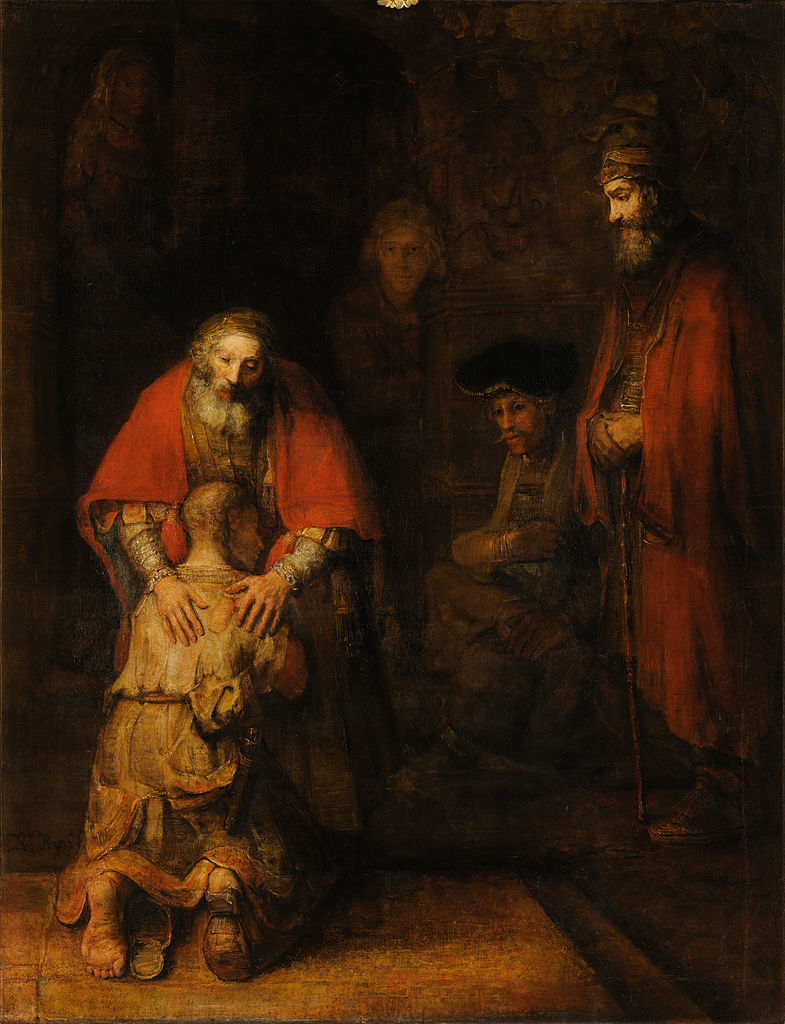
[caption id="" align="alignnone" width="277"] Rembrandt, The Return of the Prodigal Son, c. 1668[/caption]


You know what was one of the most surprising things about this Lent for me? The unexpected lessons from the Father, the bearhugs He gave me that have been both a little painful and a lot heart-warming.

He’s shown me some hard truths… some of the dirt I’ve missed -- or frankly, ignored -- but He’s been pretty gentle in how He’s done it. In my case, it was a good dose of humility... just when I think I'm well on my way to having this pride thing licked, He shows me that it's a lot bigger onion than I realized!

But even more than pointing the dirt out to me, He’s shown me how much better I look when I get cleaned up!

I used to be afraid of that kind of Fatherly discipline, but now I thank Him for it. If I remember.  :-)

What are the unexpected -- but good! -- lessons that He's taught you?

Tuesday, April 07, 2015

What to Expect When You're Reading (Cruciform)


As I’ve mentioned before, this isn’t my first blog… the first go was pretty rant-heavy and all across the board, topic-wise.

It was also very across the board in terms of frequency of posting, due to the fact that most of my posts were in response to the news of the day, oftentimes political (hence the ranting).

With Cruciform, my intent is to be more deliberate in both topics and frequency. I’ve already spoken to the focus of this site; in terms of frequency you can expect to see one lengthy post per week and two to four shorter posts.

But this is also an experiment, with the results determined in large part by the preference of you, the reader… so please… let me know what you think as we go forward. And to that end, expect me to see questions every so often about what is most interesting and helpful to you, including the regularity of my posts.

Thanks for journeying with me!

Monday, April 06, 2015

What is Truth?

“What is truth?” Those are the words of that great postmodern philosopher Pontius Pilate, uttered nearly 2000 years ago (maybe postmodern isn’t as postmodern as we thought).

[caption id="" align="alignnone" width="490"] Mihaly Munkacsy, Christ before Pilate, 1881[/caption]


While many today share Pilate’s skepticism, many others have found the Truth. Not just truths, mind you, but the Truth: the truth about themselves, about their lives, about their destiny. And with it they have found peace, joy and purpose.

You can find it too.

Are you ready?

Sunday, April 05, 2015

Hallelujah!

One thing that continues to strike me is the way that deep truths both have a certain beauty to them and provoke a beautiful response. The latter has certainly been the case with the Christian tradition and the multiple forms of artistic beauty that it inspires.

To that point, the other day I read this post listing ten classical music pieces for Easter. The author notes that he's leaving off the most well-known Easter-inspired piece, which leads us down another road...

Many Christian traditions are known for the spiritual practice of giving something up for the six week-plus season of Lent, leading up to the celebration of Easter. Catholics, for instance, give up meat on Ash Wednesday and the Fridays of Lent.

Perhaps less well-known is the practice of "giving up" the Alleluia...

As with many Christian worship services, the Catholic Mass always includes a reading from one of the four Gospels. Immediately prior to the reading comes the Gospel acclamation, typically a verse or two from the Bible, which is "bookended" by the singing of the word "Alleluia." This word is a variation of the Hebrew word Hallelujah, which is an exhortation to give praise to God.

During the seasons of Advent and Lent, however, Catholics "give up" the Alleluia, not singing it from Ash Wednesday through Good Friday. It is only at the Easter Vigil after sundown on Holy Saturday that this word is sung again.

Now that Lent is over and Easter has begun, this word -- both an exhortation to give praise to God and itself a means of giving that praise -- returns full force.

As such, it only seems appropriate to listen to what is probably the most well-known composition around this biblical word of praise: the "Hallelujah Chorus" from George Handel's 1741 work The Messiah.

So... turn the volume up to 11, click the Play icon below and listen to the Royal Choral Society's stirring performance of this classic:

[embed]https://youtu.be/IUZEtVbJT5c[/embed]

Saturday, April 04, 2015

New blog!

Well, I went and did it: I bought my own domain: www.chrisburgwald.com.  :-)

I'll keep Veritas around for posterity's sake, and to post off-topic when it suits my fancy, but expect me to be blogging primarily -- and more often! -- at Cruciform (I reserve the right to change the name!).

Christ is Risen, He is Risen Indeed!

Happy Easter!

[caption id="" align="alignnone" width="281"] The Resurrection of Christ, Paolo Veronese, c. 1570[/caption]


Thirteen years after I started blogging (to the liturgical-day: it was late on the Easter Vigil of 2002) and six years after I unintentionally took a hiatus from said blogging (kids will do that to you!), I figure it’s time to get back in the saddle again. Well, I didn’t so much figure it out as succumb to the pressure accept the encouragement of some people near & dear to me… ;-)

I see this blog as having a bit of a tighter focus that my first go… I plan to keep things focused on topics pertaining to Christian discipleship and living it out in the culture(s) of twenty-first century America.

I’m grateful to have you along for the ride… check out the About... page for more about me and this blog, and please join in the conversation by commenting or reaching out to me by email (chris@chrisburgwald.com) or twitter (@chrisburgwald).


Tuesday, May 27, 2014

Passionately Seeking Happiness and Accidentally Finding it

Back in 2006 I came across a fascinating blog: the author was an atheist who was in the midst of exploring theism, then Christianity, then Catholicism, before joining the Church (with her husband) in 2007. Throughout the process, Jennifer Fulwiler used her blog as a combination journal/forum, setting forth the questions she had and inviting responses.

Last month, her memoirs were published under the title Something Other Than God: How I Passionately Sought Happiness and Accidentally Found It. Shortly after the book was published my friend Renee read the book and then wrote a review, which I'm posting below. Take a gander and consider picking up a copy of the book yourself.


Something Other Than God: How I Passionately Sought Happiness and Accidentally Found It

Very simply, “Something Other Than God” by Jennifer Fulwiler is a conversion story.  However, what makes this book special is the journey that takes Jennifer from being a religion hating atheist to a devout Catholic.  Jennifer was raised in an atheist home, had achieved monetary and career success at a young age and yet, a part of her always wondered “is this it?”  Through a series of major life events, Jennifer began to realize that she doesn’t have an answer for the big questions in life, questions such as “what is the purpose of this life”, “what happens to us when we die”, “is there an ever loving, all good Deity.”   Her quest for answers - and the truth -  led her to create a blog on the internet where she found people who were willing to answer her questions in a logical, non-confrontational manner.  She later discovered that those individuals that were providing the best answers and could provide documentation to prove their point of view were….. Catholic.

What struck me most about Jennifer’s story is that her mother was raised Catholic.  Her Catholic grandparents, whom she never knew, had insisted that Jennifer be baptised Catholic when she was six months old.  If there was ever a doubt in my mind of the real power contained in the Sacrament of Baptism, Jennifer’s story confirmed for me in a very real way that this beautiful sacrament provides assistance to us in ways we cannot imagine, that we are sealed with the sign of belonging to Christ, an indelible mark on our soul that not even a life of unrepentant sin can wipe away.  Through the Sacraments we receive, there are powerful, unseen forces at work in our lives every single day.

Jennifer’s conversion didn’t take place over night, and her journey was filled with difficulty and uncertainty.  She fought the process the entire way, desperately trying not to believe.  She discovered that God is loving and patient and is waiting to give us peace when we finally find our way home.

Jennifer has written a book that clearly and concisely presents the arguments against Christianity and the Catholic faith, and then beautifully and thoughtfully explains why the answers and the Truth can be found within the Church.  

If you are looking for a book to help you find answers on your journey of faith, but do not want to slug through books on theology, this is a must read.  If you are looking for an uplifting book to hang out with over the summer while sitting on a beach or under a tree, this is a must read.  Wherever you are on your faith journey… this is a must read.


Wednesday, May 21, 2014

An Alternative Approach

Perhaps instead of complaining about Church leadership we might emulate the early disciples and gather around our leaders so that they receive the strength to boldly proclaim the Good News of Jesus Christ.

More below.

Throughout the Easter season the first reading at daily Mass is taken from the Acts of the Apostles, and I’ve really been struck by a variety of things, one of which I want to mention here…

In the reading from Tuesday of this week (the fifth week of Easter) from Acts 14 we read of some of the experiences which Paul had... here's the part that drew me:

"They stoned Paul and dragged him out of the city, supposing that he was dead. But when the disciples gathered around him, he got up and entered the city."

Paul -- an Apostle -- was left for dead, but when the disciples gathered around him, he arose and went back into the city.

It occurred to me that we might do the same as those early disciples did: gather spiritually around our "apostles" -- particularly our bishops, as well as the priests and deacons of our dioceses -- so that they have the strength to rise again and proclaim the Gospel anew.

Tuesday, May 20, 2014

You Keep Using That Word… I Do Not Think It Means What You Think It Means

Evangelization and catechesis… for those who have a passion for proclaiming the Catholic faith, these are commonly used words, which makes it all the more surprising that they are commonly misused, or more precisely, “mis-related”.

Let me explain.

If you analyze how most Catholics -- from the average Joe and Jane in the pew to popular theologians to well-formed priests -- use evangelization and catechesis, you’ll find that by “evangelization” they mean the proclamation of the Gospel, the Good News of Jesus Christ, and by “catechesis” they mean a systematic education in the faith.

At this point, things are okay, or at least seem to be okay. The problem comes, though, when the same people compare or relate evangelization and catechesis: typically, you’ll hear that evangelization comes first, and then catechesis. Sometimes you’ll hear that such-and-such Catholic has been “catechized, but not evangelized.”

Uh-oh.

This is where the problems arise. Implicit in such statements is an understanding of these two concepts in which they relate to one another as “siblings,” as related but distinct activities.

The problem is that that this is not how the Church formally uses and relates these concepts. This is seen in a number of Magisterial documents, but most simply and clearly in Pope St. John Paul the Great’s document on catechesis, Catechesi Tradendae, wherein he states that catechesis is one moment (or stage) in the entire process of evangelization (the actual quote is, “Catechesis is one of these moments - a very remarkable one - in the whole process of evangelization” [article 18]).

Again: catechesis is one stage in the process of evangelization. This means that the relationship between evangelization and catechesis is not one of siblings -- related but distinct -- but one of parent-child -- one is inclusive of the other. In this case, evangelization is the “parent term,” of which catechesis is the “child”, or subset.

This is an important point for a variety of reasons, one of which I’d like to highlight here: this means that catechesis, as the Church understands and explains it, is evangelical in nature. Catechesis is not distinct from evangelization… it is part of the process of evangelization.

Today we seem to be in danger of reducing catechesis merely to instruction, to a (solely) intellectual activity, to learning the “facts” of our Catholic Faith. As the quote from St. John Paul indicates, this is manifestly not the case: catechesis is, as some aptly put it, teaching (yes) to conversion to Jesus Christ. It isn’t just about learning the Creed, the Commandments, the Sacraments and the prayers so that we (just) know certain truths… it is about learning these truths so that we might grow closer to the Truth, the Way and the Life: Jesus Christ. So, if you’re actually doing catechesis as its intended by the Church to be done, you are evangelizing.

That is not to say that catechesis is synonymous with evangelization, however; again, it is one stage in the process of evangelization, and not the first stage at that. Rather, it follows the stage of primary proclamation, in which the Good News is proclaimed and an initial conversion to Christ is sought after.

Instead of “evangelization followed by catechesis,” then, the Magisterium says, “primary proclamation followed by catechesis, all of which is evangelization.” And at the heart of it all? The encounter and relationship with the God-Man, our Lord and Savior, the Eternal Word, Jesus Christ.

Sunday, May 18, 2014

Finding Meaning & Purpose in Everything

While many of us struggle today to find meaning in life, Christianity proposes that everything we do can have real significance for ourselves and others, in this life and in eternity. How? Through what is called the universal or royal priesthood of all the baptized.

Let me explain.

At every Catholic Mass today, those present heard a reading of the first letter of St. Peter, in which he writes the following: “let yourselves be built into a spiritual house to be a holy priesthood to offer spiritual sacrifices acceptable to God through Jesus Christ” (1 Peter 2:5).

While most people think of priests as the guys in white collars, the Catholic Church -- like many other Christian traditions -- also teaches that every baptized person is a priest, as well as a prophet and a king (or queen). Why? Because by our baptism we are joined to Jesus Christ, who is the priest, prophet and king, and we share in His status as such.

“That’s all well and good, Chris,” you might be thinking, “but what does that have to do with finding meaning in my life?”

This is what is has to do with meaning: because we as baptized are priests in Jesus Christ, we are able to offer everything we do -- literally, everything (apart from our sins, of course) -- to the Father as a spiritual offering, a spiritual sacrifice, and in doing so, we join our offering to Jesus’ ultimate offering on the Cross. In this offering-with-Jesus’-offering, my seemingly little and insignificant gift is invested and imbued with incredible -- even eternal -- significance: because it is joined to Jesus’ offering by which He saved all of us and indeed all of creation, so too does my offering -- by its participation in Jesus’ offering -- become salvific or saving.

In decades past this teaching was summarized in the simple saying, “offer it up,” which was usually applied to suffering, whether little annoyances or great physical or emotional pain. But the same saying can be applied to any and every act we make, and in so doing, we fill that act with great meaning and purpose.

Here’s how the Catholic Church formally teaches this reality, in paragraph 901 of the Catechism of the Catholic Church:

“For all their works, prayers, and apostolic undertakings, family and married life, daily work, relaxation of mind and body, if they are accomplished in the Spirit - indeed even the hardships of life if patiently born - all these become spiritual sacrifices acceptable to God through Jesus Christ.”

Our daily work, the joys and struggles of family and married life, even the things I do to relax my mind and body… all of these things can be offered to the Father through Jesus, and in so doing become salvific, redemptive… saving.

I continue to be struck by this reality, and I continue to strive to live it out in my daily life, and in so doing, to give everything I do meaning & purpose.

What about you? Is this a new insight, or something you’ve been aware of? If the latter, how have you been able to live this out in your own life?

Saturday, May 17, 2014

Links

One of the "dangers" inherent in awaking a long-dormant blog is the blogroll... yes, I know that most of the sites and links over to the right are long dead... I'll get to them as I can.

In the meantime... may the clicker beware.  :-)

Materialism and Concern about the Future of Our Species

If, as Carl Sagan said, the cosmos (matter) is all that is or was or will be, then concern about the future of our species -- and hence concern about climate change and zombie apocalypses alike -- doesn't make any sense.

Let me explain.

My favorite contemporary director is Christopher Nolan; way before his Batman trilogy saw the light of day, I'd been enthralled by Memento. Later, I was similarly taken by The Prestige and Inception. This year, I'm looking forward to Interstellar, due out this November, and just the other day we were treated to the first (non-teaser) trailer, in which we get a glimpse of what this movie is about: "As Michael Caine tells hero Matthew McConaughy in the new trailer, mankind 'isn’t meant to save the world' in the wake of what appears to be a natural disaster that has meant an end to food production on Earth, but instead leave the planet in search of new beginnings" (HR).

As I was reading various responses to and interpretations of the trailer, I came across this post, in which the writer comments on the apparent natural disaster that originates the plot of the movie:

I completely buy the trailer's vision of a future weather and resource global crisisThe global data is unquestionable. Man-made or not, I don't care, the fact is that climate change ishappening. It's drastic and it's accelerating, and we may not be able to stop it at this point.
Computer simulations show that we are headed to a place where humanity hasn't been before. The projections are so bad that the military have deemed it a national security threat already. And trust me, the men and women of the Pentagon are not tree-hugging hippies.
As climate changes, everything changes. We are already seeing the effects on agriculture, with ruined crops and food scarcity in many parts of the world. Or better said, we are not seeing it—people who live in third world countries are. Our oceans' fisheries are also dwindling quickly, with many species on the verge of exhaustion.
Combine this with the millions of poor people getting out of poverty conditions in China, India, South America and Africa. They are consuming more and more of resources that are already scarce. More food. More energy. More oil. More everything. Even if the population doesn't go up, the demand will keep increasing at a fast rate. It's not going to stop.
Still, I'm an optimistic person who thinks that science may save us at the last minute. Perhaps that's Nolan's thesis—or perhaps it's the contrary. We don't really know yet. But I have no doubt that we are headed into this direction.

As this citation as well as the rest of the post make clear, the author believes strongly that there will be very dangerous consequences for humanity as climate change continues to unfold. As I thought about this passage and similar views held by others, I was struck by the incongruence between the materialists' belief that matter is all there ever was, is and will be and their simultaneously-held deep concern for the future of the human race. After all, we're all going to die at some point... if this life is all there is, why does it matter if we all die at (about) the same time in some extinction level event? If materialism is true, there is no logical reason for me to be concerned about the fate of the human race. For that matter, if materialism is true, there is no logical reason for me to be "concerned" about my fate: that I will someday die is a cold, hard fact, and it's irrational to struggle against it. (A separate yet even more important point is this: concern about my own fate or that of any other person or group of persons is -- given the materialist view of reality -- irrational because the human being is nothing more than a particular grouping of atoms... why favor this type of grouping over any other? Simply put, the concept of human dignity is meaningless in the materialist conception of reality.)

Let me be clear: I am not arguing that we ought not be concerned about climate change and its consequences, nor am I arguing that we ought not be concerned about the fate of the human race. My point is simple: if materialism is true, there is no rational basis for concern about the future of our species, and hence for concern about climate change.

What do you think? Does my argument fail, and if so, where?

Resurrexit!

Wow. Six posts in the last six years. Let's see what we can do about that...